



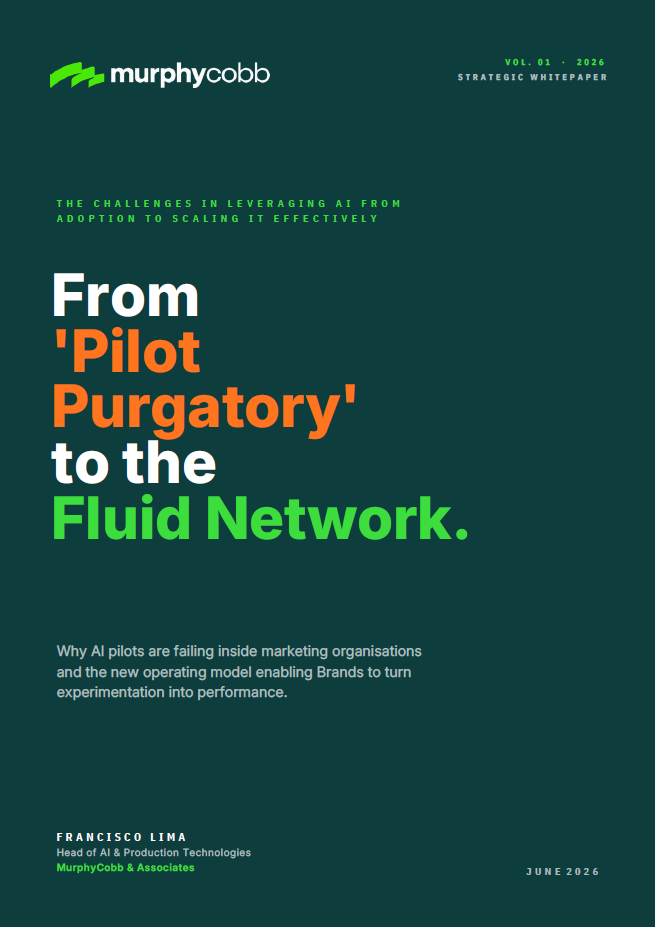
From Pilot Purgatory to the Fluid Network
AI should be transforming marketing. Instead, most organisations remain stuck in pilot purgatory – running tests and proofs of concept that never scale, never integrate, and never deliver meaningful value.
Our new paper, From Pilot Purgatory to the Fluid Network, written by our Head of AI and Production Technologies Francisco Lima, explores why this happens and what needs to change. Francisco is a leading expert in AI‑enabled operating models, and this paper reflects his deep experience helping global brands move from experimentation to real transformation.
The findings are clear: The barrier to AI success isn’t technology. It’s organisational design.
Marketing teams face resistance to change, skills gaps, rigid workflows and a lack of governance – all of which prevent AI pilots from scaling. According to MIT’s July 2025 report, 95% of AI pilots fail to impact profit and loss, not because the tools don’t work, but because the operating model around them cannot support scale.
At the same time, years of agency consolidation have created ecosystems that look simpler on paper but are more complex in practice; siloed, linear and slow to adapt. This makes AI integration even harder.
CMOs are now asking the same critical questions, How do we transform without locking in? How do we scale AI safely across ecosystems? How do we orchestrate capabilities without losing control? How do we build governance that keeps pace with innovation?
This is where MurphyCobb works differently.
We focus on operating model redesign – restructuring how work flows, how teams collaborate and how AI integrates across the entire production ecosystem. We build governance from the start, embed change management, and connect global capabilities without vendor lock‑in. It’s an architecture‑first approach, grounded in more than 20 years of experience in global marketing systems.
The paper introduces The Fluid Network – a modular, AI‑ready operating model designed for agility, interoperability and continuous optimisation. It replaces fixed vendor structures with dynamic orchestration, modular capability pods and ecosystem‑wide data feedback loops. The result is a system built for speed, flexibility and safe scaling.
For organisations looking to unlock real value from AI, the question is no longer which tools to buy, it’s whether the operating model can support them.
Download the paper: